Custom Onboarding Paths for the Mid-Market
Custom onboarding paths cut early turnover in the mid-market. Build an onboarding matrix, automate path assignment, and track the KPIs that matter.
Contents
- Why tailored processes reduce turnover
- Contents
- TL;DR
- Why does a one-size-fits-all onboarding no longer work?
- What are custom onboarding paths?
- How does the onboarding matrix work?
- How do you roll out custom onboarding paths in the mid-market?
- Is automated path assignment realistic?
- What strategic benefits do custom onboarding paths offer?
- Download the onboarding checklist
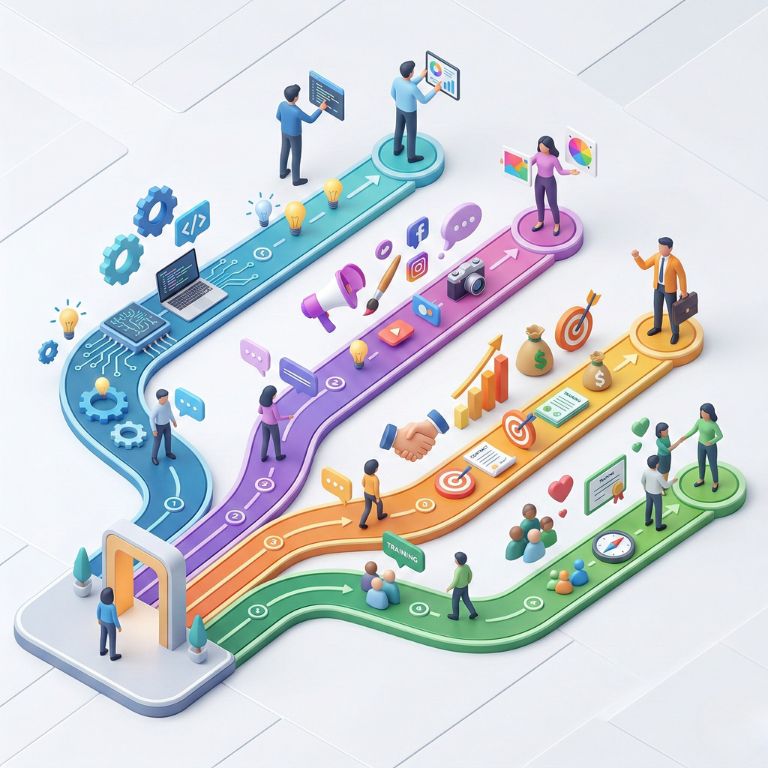
Standardisierte Onboarding-Programme führen oft zu hoher Frühfluktuation. Individuelle Onboarding-Pfade verbessern die Integration und Mitarbeitendenzufriedenheit.
Why tailored processes reduce turnover
Reading time approx. 5 minutes
Breadcrumb: mana HR → HR Knowledge → Blog → Custom Onboarding Paths
Contents
- Why does a one-size-fits-all onboarding no longer work?
- What are custom onboarding paths?
- How does the onboarding matrix work?
- How do you roll out custom onboarding paths in the mid-market?
- Is automated path assignment realistic?
- What strategic benefits do custom onboarding paths offer?
- Frequently asked questions
TL;DR
Custom onboarding paths align the ramp-up of new employees with their role, complexity, and level of responsibility. In the mid-market, this reduces early turnover, shortens time-to-productivity, and raises satisfaction through content that actually fits. An onboarding matrix and automated path assignment make this workable even with limited resources.
!Four tailored onboarding paths shown as color-coded routes for engineering, marketing, sales, and HR
Author: Dominik Becker · Published: 07/04/2026
Share on LinkedIn · Share on XING · Share on Facebook
Why does a one-size-fits-all onboarding no longer work?
Standardized onboarding processes do not reflect the range of roles inside a company. When a manager and a customer support agent go through the same introduction, it often does not fit.
This mismatch creates real drawbacks:
- Lost efficiency from irrelevant content
- Poor integration into teams and company culture
- Higher early turnover from a lack of orientation
With a generic one-size-fits-all process, you lose valuable time and risk losing new talent early.
What are custom onboarding paths?
Custom onboarding paths are more than a tweak to the standard process. They deliberately account for the variety of roles in the mid-market and offer tangible benefits:
- Faster ramp-up through content that fits the role
- Higher employee satisfaction through relevant processes
- Better employee retention through early engagement
According to a study by Harvard Business School, personalized onboarding that reflects an employee's individual identity shows a 32% lower attrition rate in the first six months compared to standardized onboarding processes.
Along the way, keep the 5 onboarding must-haves you should not forget in mind to build lasting employee relationships.
How does the onboarding matrix work?
An onboarding matrix helps you sort roles by their complexity and autonomy. Three standard paths can be defined:
- Quick start: For simple roles with clear tasks and responsibilities
- Structured transfer: For complex, technically demanding positions
- Leadership enablement: For managers with broader requirements
A diagram or infographic can help you show the complexity visually and make decisions easier.
Building a custom onboarding matrix for your company pays off over time through higher employee satisfaction.
How do you roll out custom onboarding paths in the mid-market?
Companies that introduce tailored onboarding programs report improvements in employee retention over the first six months. This comes from:
- Practical use of the matrix with clear ownership
- Step-by-step involvement of different departments and stakeholders
- Continuous improvement through feedback and KPI measurement
Feedback during onboarding is essential here. It keeps quality improving and lets you adjust as you go.
Is automated path assignment realistic?
Yes. Integrating this into recruiting software is workable for mid-sized companies too. By tagging at contract signing, you can trigger automated workflows:
- Example: A tag like "High Complexity / Remote" automatically starts the matching onboarding process
- Technology: Modern recruiting and HRIS systems support workflow automation
- Resources: Even with limited IT resources, you can automate step by step
If you want to know how to set up automated path assignment, it is worth taking a look at digital solutions for your onboarding.
What strategic benefits do custom onboarding paths offer?
Custom onboarding paths offer lasting strategic benefits for your company:
- Focused use of resources for faster time-to-productivity
- Better employee retention through a ramp-up that fits
- Higher appeal as an employer in the competition for skilled staff
Questions to reflect on: Do you recognize specific role needs in your company? Where could tailoring make an immediate difference?
Closing thought: Is now the moment for your own custom onboarding path?
Updated: April 2026
Download the onboarding checklist
Motivation and retention from day one, with our onboarding checklist.
- 20 structured steps for a well-rounded pre- and onboarding, from contract signing to the end of the probation period.
- Tips for emotional entry points such as welcome packages, team lunches, or remote coffee meetings.
- Clear orientation and fast execution through proven workflows, recommended tools, and a helpful checklist structure.
Für dieses Formular nutzen wir Mailerlite. Hierfür brauchen wir deine Zustimmung. Möchtest du die Präferenz-Cookies akzeptieren & das Formular laden?
[Formular laden]